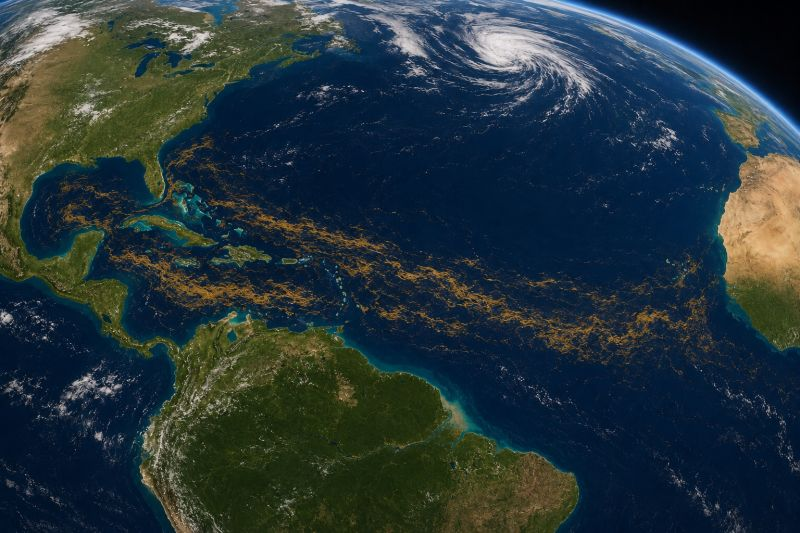
Anyone who follows the subject of sargassum will be aware of the scale of the plague that is washing up on the shores of Florida, Mexico, Belize, Caribbean nations, and all the way down to the northern coast of Brazil (a broad region that Thalasso calls the “zone”). The problem has been growing for fifteen years, becoming a major environmental and economic blight by 2018, and continuing to inflict severe damage across the region ever since.
Solving the propagation of this pan-oceanic infestation is beyond the remit of Thalasso. Finding ways to turn this waste into blue gold is. Many companies are already active in this area and are making financial progress with specialized products. Competition is welcome, as the scale of the infestation far exceeds the current market capacity to utilize it. Thalasso is pursuing its own business objectives based on sargassum transformation.
While we are busy with design, research, and product development, we are also being pulled into various government initiatives to develop a full-blown, export-driven industry across the zone. In this area, our focus is on the big picture and the strategy required to succeed from the outset.
Through this ongoing endeavour, we have uncovered many challenges and obstacles that are quite unique to sargassum. One instance is transportation across long distances, owing to the fragility of harvested sargassum. Another is tied to the logistics of collection and harvesting in the current free-for-all environment, largely bereft of regulations.
Protection of marine ecosystems, both nearshore and offshore, is another challenge that, absent logical but stringent regulatory oversight, could open the seas to harvesting pirates uninterested in environmentally responsible practices. Regulations themselves are also becoming a challenge, as differing national interests are creating a fragmented permitting environment for operators who ultimately need access to a market spanning the entire zone, rather than being limited to individual beaches.
Health issues are also coming to the fore in the handling of sargassum, as well as the surprising absence of global standards for the purity of derivative products with respect to arsenic, heavy metals, and other contaminants. This list is only partial, yet it illustrates the kinds of questions that must be clarified before a viable sargassum industry can emerge.
It’s not engineering, but it sure is exciting nonetheless to Thalasso!